Moretz Law Group - Community Associations and Business Lawyers

Monday, August 7, 2023

Board of Directors Attendance Requirements - Mandatory or Permissive?

The bylaws (note that it's one word; not "by-laws" or "by laws") of many homeowners associations and condominum associations often contain a provision stating that the board of directors "shall have the power to remove any board member who misses 3 or more consecutive board meetings", or words to that effect. This is a very common provision which appears in almost every HOA’s bylaws, although at least in North Carolina such a provision is not required by law. What is the board to do with such a provision?

While a board certainly does not want to encourage its members to skip meetings, these provisions are almost always permissive, not mandatory – they allow the board to remove a director who misses too many meetings, but do not require the board to do so. Check your own homeowners association's bylaws to be sure, but "powers" of the board are things it may do if it wishes, but is not required to do.

Contrast these powers with what is often the next section of many association bylaws, which provides a list of "duties" which the board is required to undertake. Duties are things the board members must ensure are reasonably accomplished on a regular basis in order to fulfill their fiduciary duties, and those of the board as a whole. 

Bottom line, provided that removal of a board member who misses too many meetings is only listed in your bylaws as a "power" and not a "duty", the board of directors is not required to remove a director who misses too many meetings, but it does have the power to do so, and should definitely strongly consider doing so if there is a director with repeated attendance issues. Boards should at the very least discuss the matter with the problem director and make sure there is a clear expectation in place of regular attendance, or else encourage the director to step down in favor of someone with more time to devote.

What about other behavior problems with board members, like sharing internal board discussions throughout the neighborhood, failing to keep legal or collection matters confidential, or refusing to abide by a properly-made board decision? For that you need a separate ethics and confidentiality policy which ties in with your bylaws to allow disciplinary action to be taken. But that is a subject for another blog post! In the meantime, if we can be of assistance to your North Carolina or South Carolina homeowners association, property owners association, or condominium association, drop us a line at info[at]moretzlaw.com or visit us online at www.moretzlaw.com and www.HOAninjas.com. Thanks for reading the NC HOA Law Blog!

Friday, June 17, 2022

North Carolina Supreme Court Limits HOAs' Ability to Restrict Solar Panels

Here's the house in question: What do you think?

Today the N.C. Supreme issued its ruling in favor of the homeowners in the case concerning the HOA’s authority to prohibit solar panels on the front of a home via an architectural review decision as opposed to where such panels are specifically prohibited in the recorded restrictions for the HOA. The decision by the Supreme Court overruled both the trial court’s and the Court of Appeal’s decisions. The Court was divided 4-3 and the opinion includes strong dissents by three conservative justices including the Chief Justice. 

The case involved the interpretation of N.C. Gen. Stat. 20B-20, which generally prohibits unreasonable restrictions on the installation of solar collectors, but which contains a very specific exception in subsection (d) thereof allowing homeowners associations to prohibit solar collectors on the fronts of homes. That exception reads as follows:

(d) This section does not prohibit a deed restriction, covenant, or similar binding agreement that runs with the land that would prohibit the location of solar collectors as described in subsection (b) of this section that are visible by a person on the ground: (1) On the facade of a structure that faces areas open to common or public access; (2) On a roof surface that slopes downward toward the same areas open to common or public access that the façade of the structure faces; or (3) Within the area set off by a line running across the façade of the structure extending to the property boundaries on either side of the façade, and those areas of common or public access faced by the structure.

Seems pretty clear, right? In a somewhat tortured analysis, the majority determined that this language allows homeowners associations to prohibit front-facing solar panels only if the restriction appears in the association's recorded restrictions, and not if the prohibition is made by the association (or its architectural review committee, in this case) pursuant to its architectural review process, even if its architectural review is granted very wide latitude in the recorded documents, as it was in this case.

A number of liberal (North Carolina Attorney General Joshua Stein's office) and pro-solar-industry groups weighed in on the case by submitting briefs encouraging the Court to overrule the Court of Appeals, and it appears that the decision had an unenunciated policy basis behind it aimed at encouraging the use of solar power, which is admittedly the stated intention of the statute.

In our mind, the dissent (and the Court of Appeals) makes the better argument, and of course we are in general in favor of decisions which support rather than limit community associations' authority to determine what is best for their neighborhoods. But like it or not, the decision of the majority controls, meaning that HOAs now do not have authority to prohibit solar collectors on homes unless that authority is specifically set forth in the HOA’s recorded restrictions, or an amendment thereto - the decision cannot be simply based on the HOA's architectural review authority. The case is Belmont Association v. Farwig.

Contact us if we can assist your association in implementing its own enforceable restrictions and rules and regulations.

Monday, May 23, 2022

HOA transfer fees - are they enforceable in North Carolina? What about in South Carolina?

WSOC-TV interview
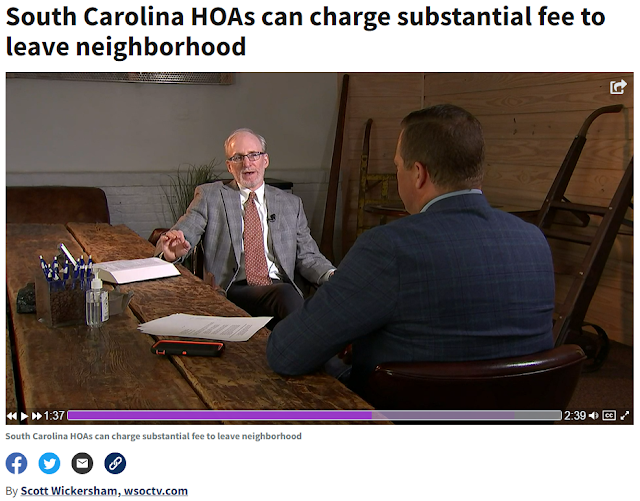
WSOC-TV interview re HOA transfer fees

We were pleased to be featured on today's WSOC-TV news in an investigation by reporter Scott Wickersham about HOA transfer fees. You can watch the report here: South Charlotte HOA charges substantial fee to leave neighborhood

We could write pages about the topic, but suffice it to say that for any North Carolina HOA or condominium created on or after July 1, 2010, transfer fees, meaning any fee paid to the HOA or anyone else, are prohibited except for from the first purchaser from the developer

While HOAs or condominiums created prior to that date are excluded from this prohibition, any HOAs considering enforcing a transfer fee by lien or other legal action should take great care and consult with their attorneys first.

Fees paid to the HOA or the HOA's management company for closing certifications or payoff letters are NOT considered transfer fees as long as they do not exceed $200 (plus an additional $100 rush fee if needed within 48 hours.)

In South Carolina, transfer fees are NOT regulated and are purely a matter of your HOA's recorded restrictions. You have read those, right?

As always, you need to get involved in your HOA and be aware of not only where its money is going, but also where it is coming from - it could be from you when you go to sell your home. All associations are required to have an annual meeting, and in North Carolina, additionally are required to have an annual budget meeting where the budget for the upcoming year is reviewed with the members. 

Avail yourself of these opportunities to be aware of where the association’s funds come from and where they go! Get involved in the budget process so you are not surprised when charges may become due at closing.

At closing, buyers and sellers can only be made to pay what they have legally agreed to pay as between the two of them. The closing attorney works for them. Subject to the terms and conditions of the purchase agreement between the parties, the closing attorney should not put anything on the final closing statement which is objected to by either party.

Folks buying or selling homes need to review the closing disclosures carefully and as far ahead of time as possible! Be prepared to delay closing if necessary until your concerns regarding what you are being charged at closing are satisfied. This means not having movers scheduled at the home for the same day that closing is scheduled, for example. Sellers in particular have little bargaining power at the closing table, and even more so if there are movers moving their furniture out the front door at the same time they are reviewing the closing documents for the first time.

We represent HOAs and condominium associations throughout North Carolina. We DO NOT represent homeowners in disputes with their HOAs. Please contact us if we can be of service to your HOA.


Monday, October 18, 2021

Special Assessments: What HOA and Condominium Board Members, Owners and Buyers Need to Know

Champlain Towers condominium collapse
Repairs to the Champlain Towers over time funded by special assessments might have helped avoid the disaster.

Special assessments are a topic that comes up only occasionally with most single-family residential homeowners associations, but can come up more frequently with townhome associations or condominium associations, and even more often for condominiums located at the coast.  That's because buildings on the coast suffer weather-related effects that can require major, costly repairs to the exteriors of the buildings.  The recent Champlain South Towers condominium collapse disaster in Surfside, Florida has brought scrutiny to the issue of how homeowners and condominium assocations can undertake costly maintenance.

The North Carolina Bar Association and North Carolina Association of Realtors have also recently adopted revisions to the sections addressing special assessments in their jointly-approved residential Offer to Purchase and Contract, effective July 1, 2021. These revisions have generated questions.

This post looks at the issue of special assessments from three perspectives – that of HOA or condominium board members, that of HOA or condominium owners, and that of someone considering buying a home in an HOA or condominium.

Board of Directors Considerations Regarding Special Assessments

If you are a officer or director serving on the board of a homeowners association, what do you need to know about special assessments?  First, special assessments are not really addressed in the North Carolina Planned Community Act or the North Carolina Condominium Act.  Since they are solely a creature of your association's governing documents, you need to carefully read those documents to see what they say about what special assessments can be used for and the process required for them to be approved. 

As always, read your main declaration first, but also don't forget to read any and all amendments which may have been made to it, as well as your bylaws.  Some associations have restrictions on how special assessments may be used - for example, only for capital improvements, rather than for operating expenses - and almost all have specific requirements for how special assessments must be implemented.  Typically, a membership vote is required, and oftentimes the required vote is a higher percentage than is otherwise required.  Pay special attention to whether the approval percentage required is a percentage of the entire membership of the association, or just of those voting at a meeting or by ballot at which a quorum has been established. 

While it is common to see special assessments only allowed for capital expenses, and with super-majority voting requirements of the membership required for approval, these are generally a bad idea in our opinion.  An association has to be able to pay its bills, and in the case of a condominium with serious structural or water intrusion issues, the process should not be so difficult as to prevent the association from moving forward with needed repairs.  If you need further proof of that statement, see the Champlain South Towers condominium collapse.  If your HOA has significant restrictions on how special assessments must be passed or how the funds can be used, consider speaking with an experienced HOA attorney about amending them, especially if your HOA consists of stacked (i.e., multi-floor) condominium units.

Once a special assessment is approved by the membership, it must then be formally adopted by the board of directors of the association.  (Note: These two steps could happen in reverse order depending on the association’s documents, but the bottom line is that special assessments typically must be approved by both the board and the membership.) At the time a special assessment is adopted by the board, the board should be very specific in adopting procedures as to how the assessment may be paid by the owners, since typically a special assessment is a larger amount and often boards will allow homeowners to pay them over time. 

The proper procedure is to add the full amount of the special assessment to the homeowner's account at the time it has been approved by both the board and the membership and has become effective.  The board may allow owners to make payments over time, but this should only be extended to creditworthy owners who are current on all their obligations to the association. The board should also consider including details making the special assessment payable in full should the home change hands.  In addition to allowing the association to receive the funds that it needs, doing so also provides certainty to sellers and buyers when there is a sale.

Homeowner Consideration Regarding Special Assessments

If you are an owner in an association which is considered a special assessment, look into the matter carefully and make sure that the board has done its due diligence in determining that the special assessment is really needed, and also in obtaining multiple bids if a major construction or renovation project is involved.  (We recommend always getting the association's attorney involved if there is major construction involved. Renovation construction projects, especially on condominium buildings, can be very complicated, and such contracts need to be drafted very carefully to address all sorts of contingencies which are outside of the scope of this article, but which can make a huge difference in whether the project is successful or not.)

 Don't be one of those people who votes no on anything that might raise your dues.  The board members are homeowners as well, and they don't want to pay a special assessment any more than you do.  A special assessment will probably only be proposed if it's really necessary.  At the end of the day, it is the board's job to keep the property values up and maintain the common elements, and if a special assessment is needed to do so, this benefits all owners in the community, even if the immediate financial commitment is difficult at the moment.  Again, see the Champlain South Towers condominium collapse disaster if you have doubts regarding the duty of all owners to chip in to make sure needed repairs get done.  Or, consider what happens to the value of your investment in your home if it becomes known to the public that your association if unable to generate the funds necessary to properly to maintain its buildings.

 What if You Are Considering Buying Into an HOA with Special Assessments?

Finally, if you are a potential buyer within a homeowners association, especially if it is a condominium association with multi-floor buildings, or located at the coast, inquire very specifically as to whether there are any special assessments, either under consideration or in place, and get it in writing.  Sometimes you will see the term “confirmed special assessment”.  That is a redundancy - this just means it's an actual special assessment that is due and payable.  If so, the amount due will need to be prorated at closing between you and the seller, and this can sometimes be confusing if the payments are due over time.  See the discussion above on this topic.  As a buyer, you will want to get as much in writing as possible from the board and the seller as to how much is due and a clear understanding of what, if any, your future obligations will be based on how much is paid between the two parties at closing.

We are attorneys licensed in the state of North Carolina only, and this post is obviously general in nature and does not constitute legal advice.  Please reach out to us if we can help your association with a special assessment approval process or an upcoming construction project.  While we hope our blog posts are instructive for all folks interested in community association matters, keep in mind we represent associations exclusively and do not represent homeowners in disputes with their associations.  Thank you for reading!

Friday, September 3, 2021

Recent Cases Cause Uncertainly Regarding Residential Restrictions and the N.C. Real Property Marketable Title Act

You may have heard about the recent pair of cases decided by the North Carolina Court of Appeals involving the North Carolina Real Property Marketable Title Act, which is codified at NCGS Chapter 47B.  The two decisions are C Investments 2, LLC v. Auger et al., and C.E. Williams III et al. v. Reardon et al. These decisions will have a significan adverse impact to North Carolina HOAs and condominiums if allowed to stand - but we don't believe that they will be allowed to stand.

The Marketable Title Act was passed almost 50 years ago and was designed to extinguish certain title flaws or encumbrances, if they had not appeared in any recorded documents within a given chain of title within the past 30 years.  The point was to clarify title and remove minor, old or forgotten matters of title if they had not reoccurred, been rerecorded, or been litigated within the past 30 years of when the title was being examined.  The Marketable Title Act has a number of exceptions for things which are not extinguished even though they may be more than 30 years old, including an exception for "covenants applicable to a general or uniform scheme of development which restrict the property to residential use only, provided said covenants are otherwise enforceable."  This exception had always been interpreted by real property and homeowners association lawyers to mean that restrictive covenants for residential subdivisions were excepted from the Marketable Title Act and therefore remain in place in perpetuity, as most covenants specifically provide, even if they are older than 30 years and even if they don't appear in a given chain of title within the past 30 years.

The Court of Appeals unfortunately ruled contrary to the longstanding common opinion and practice, interpreting the above-quoted provision to mean that residential restrictive covenants which have not appeared in a given chain of title within the past 30 years are completely extinguished, other than any provision specifically restricting the property to residential use only.  While the Court of Appeals took the position that this was a plain reading of the plain words of the statute, that reading if allowed to stand would upend every subdivision with restrictive covenants 30 years or more old and cause chaos in the chains of title of thousands of homes and residential subdivisions statewide.

For example, imagine an older subdivision with residential restrictive covenants of the typical sort, which were originally recorded more than 30 years ago.  Mr. and Ms. Jones reside on Lot 1 and have lived in their home for 31 years.  Mr. and Ms. Smith live on Lot 2 and just bought their home last year.  Based on these Court of Appeals rulings, the covenants are now extinguished on Mr. and Ms. Jones' property, other than the restriction that it can only be used for single family residential purposes.  So they can quit paying dues, maintain old junked cars on cinderblocks in their front yard, and allow their home to fall into complete disrepair.  On the other hand, what is the situation next door at the Smiths?  It depends on what the deed they received said, and what the deeds of all the other folks in the chain of title for their lot in the past 30 years said.  If the recorded restrictive covenants were mentioned in any of those deeds, then by the Court of Appeal's reasoning, they have been revived and the Smiths must comply with every provision of those restrictions.  If none of the deeds mentioned the restrictions, then they get to be scofflaws just like their neighbors the Joneses.  What if their deed said something vague like, "This deed is subject to all documents of record"?  Who knows?  The Court of Appeals doesn't tell us.  Thus, chaos.

It is a universal opinion among real property and homeowners association attorneys in the state that these decisions were wrong.  The General Assembly is currently reviewing legislation to make corrections to the Marketable Title Act that will put things back the way they have always been.  The chaos which will result if that does not happen it is a strong assurance that it will. 

Bottom line: We do not believe that this is a situation which should be of concern for North Carolina HOAs or condominiums at this time. We believe the General Assembly will remedy the matter. Of course we will be monitoring the situation and will provide further updates as they occur.

Contact us if we can provide any further information, and thank you for following the NC HOA Law Blog.

Friday, May 28, 2021

When it Rains, it May Pour on Your Homeowners Association

Do you have one of these lovely structures in your yard?
 
It seems like it rained most all of this past winter.  It rained for 4 days straight as this post was being written, and regardless of your beliefs regarding climate change, it is a fact that we in the Carolinas have had more than our fair share of rain over the last few years.

Rain, and the flow of it across the ground that we call storm water management, is probably the most common issue we face regularly as homeowners association attorneys.  I've certainly been fielding a lot of calls lately about it. 

The general rule regarding storm water is that a property owner is not liable to neighboring property owners for storm water flowing across his or her property onto their property, unless the property owner has changed the natural flow of storm water across his or her property in a way that adversely affects the neighbor by directing more water onto the neighbor's property than would otherwise naturally occur.  

Thus, in general, each homeowner in a homeowners association is responsible for storm water flow across his or her property and cannot blame his or her uphill neighbor for storm water naturally flowing downhill onto his lot, unless he can show that the neighbor made changes to his lot which are directing an unnatural amount of water onto him/her.  It is important to keep this common law concept in mind if you are having grading work done on your property or putting in an in-ground swimming pool, for example.  You must do so in a way in which manages the storm water on your own property and does not direct additional storm water onto your neighbors.

We often hear from our homeowners association clients when property owners in the neighborhood demand that the association step in to correct adverse drainage across the owner's lot.  Take a look at this awful situation:


Unfortunately in almost all cases, the homeowner's wish to make poor drainage the association’s responsibility is headed down the drain.  Unless the restrictive covenants provide otherwise, storm water pipes, drains, swales, ditches, and the like on a homeowner's lot are that homeowner's responsibility to maintain, and an individual homeowner rarely has recourse against any other parties for excessive storm water coursing across the surface of his or her lot, or for the maintenance and repair of storm water pipes installed within their lot. That bell tolls for him or her and no one else.

In general, homeowmers own their lots down to the center of the earth and up into the sky as far as the eye can see, and everything in between.  This includes any storm water pipes installed on or under the property, even though the storm water pipe was probably installed by the developer or the home builder, not the homeowner, and even though the storm water pipe may drain water from other lots, common areas, or roads of the neighborhood and not just from the homeowner's own lot.  

From the prospective of the homeowner's association, this is the correct result.  The primary purposes of a homeowner's association are to maintain property values and maintain the common elements.  It is not a police force, nor is it a public works department.  The association did not design, approve, or construct the lots or the roads, nor does it usually have the right to go upon lots to correct topography or drainage, nor does it typically have the financial resources to do so.  The homeowner must generally look to his or her own resources or confer with their neighbors to address storm water problems.  

Occasionally, storm water apparatus may be maintained by the local municipality, and if so that municipality should always be the first recourse to assist with storm water issues.  Most cities and counties have storm water engineers on staff due to the increasing requirements of the federal government under the Clean Water Act and most are more than willing to come out and meet on site to examine issues.  Occasionally, there may also be issues with storm water catch basins or drains constructed within city streets or state-maintained roads, so the city transportation department or North Carolina Department of Transportation, if a state road, are often good resources.  Remember that in North Carolina, counties do not maintain roads, so do not call your local county government with street or road related issues in most cases.

 The only instances where a homeowner's association might have liability for storm water issues are where the association owns adjacent common area.  If the association itself has made topographic changes to common area it owns and which is causing adverse drainage onto a neighbor's lots, then it of course may be liable.  And in some case, the restrictive covenants for the neighborhood specifically provide that the association is to maintain the storm water management structures throughout the neighborhood.  (This would occur more often in a commercial property owners association, or sometimes in a condominium or townhome situation – almost never in a single-family detached subdivision.) 

 If the subdivision has private roads which are maintained by the association, the same situation as described above with city or state roads might apply, so the association needs to make sure any catch basins or storm drains within its privately-maintained roads are properly maintained so that they are draining the roads as originally designed.  But again, the association did not design, approve, or construct the roads, so it generally cannot be held liable for inadequate design, but only for failing to reasonably and properly maintain those specific storm water management devices which are within its private roads, or any catch basins or similar devices it owns or maintains.  Storm water pipes, ditches, drains, and swales on individual lots generally do not fall within this area of responsibility.

Don't hesitate to contact us if we can assist your association, whether during rain or shine or sleet or dark of night!


Tuesday, October 20, 2020

Huge Investment Funds Are Snapping Up Hundreds of Thousands of Single Family Homes and Turning Them Into Rentals


"Real-estate investors have a mountain of money looking for a home. Lately a lot of it is ending up in suburban single-family houses."

Invitation Homes, one of the largest single-family home rental companies, just received another $1 billion of funding in order to add more rental houses to its 80,000-home portfolio. American Homes 4 Rent and Tricon Residential are aggressively buying as well. Links to a couple of articles on the subject are posted below.

Huge investment funds would be happy to take over your neighborhood. Homeowners' associations need to be aggressive in adding and enforcing rental restrictions, especially those in the $150,000 to $300,000 price range, or they will find themselves quickly turning into rental communities. 

Contact us if you'd like help protecting your HOA.

https://www.wsj.com/articles/invitation-rockpoint-forge-1-billion-rental-home-venture-11602067500

https://www.theatlantic.com/technology/archive/2019/02/single-family-landlords-wall-street/582394/

Monday, August 31, 2020

Community Association Management Insider Quotes Moretz Law Group on Association Easements

Sea Watch at Kure Beach boardwalk

Were were pleased to be quoted in this recent edition of Community Association Management Insider on the topic of easements encumbering HOA common areas and lots and benefiting the homeowners in the association.

Bottom line: Be careful when granting or receiving an easement. Always state what the intentions of the parties are, and be sure to think about what might be needed in the future so your easement is not too narrow, if you're the one receiving it. On the other hand, if your property is being encumbered by the easement, make sure you are specific as to any limitations involved, or you could end up like the homeowners in the Sea Watch at Kure Beach Homeowners Association case discussed in the article and also in our blog post here.

Read the full Community Association Management Insider article here.

Read our April, 2020 blog post on HOA easements here.

Consider hiring us or an experienced HOA attorney regarding any easement issues.

Tuesday, April 21, 2020

Stay Out of My Tiki Hut! Court of Appeals Explores Extent of Access Easements in Recent Case

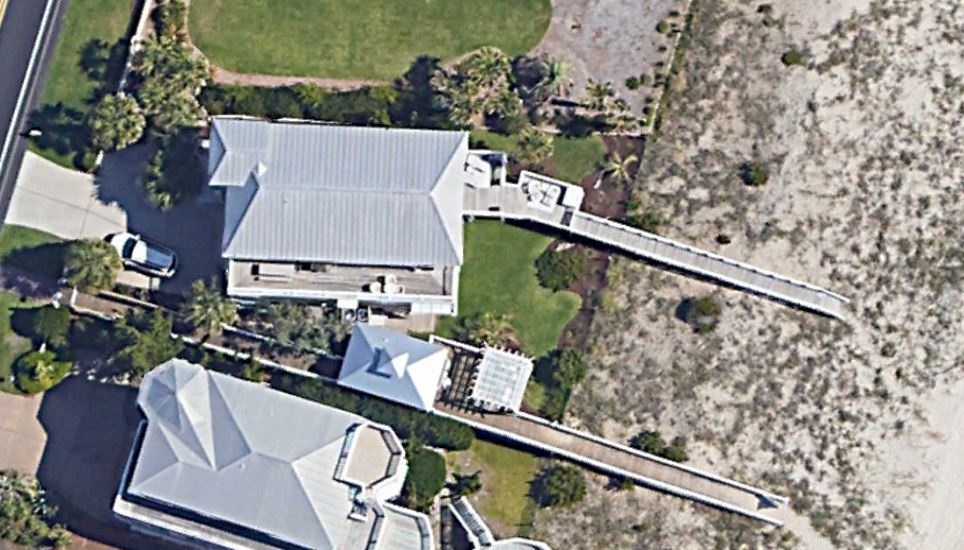
The Fiorentino home as seen from the street,
with the beach access boardwalk.

The North Carolina Court of Appeals issued an entertaining decision in Sea Watch at Kure Beach Homeowners' Association v. Fiorentino in November 2019.  In this case, a developer of a seaside residential community had reserved an access easement across a homeowner's lot, Lot 6, for other residents to access the beach.  Eventually, the access area was expanded to include not only a wooden boardwalk, but also a deck area, bathrooms, and a tiki bar.  After these improvements had been in place and in use for approximately 10 years, a homeowner who bought Lot 6 demanded that the improvements be removed and the easement area returned to its original documented use as set forth in the easement agreement for access to the beach only.  The homeowners association eventually filed suit and requested a declaratory judgment, which is a request for the court to declare the respective rights and obligations of the various parties.

The Fiorentino home in question is at top in this picture with what admittedly looks like a pretty large tiki hut on the walkway between the two homes shown.
             After a Superior Court trial, the trial court ruled in favor of the HOA and dismissed the counterclaims of the owner of Lot 6. The court stated that the improvements were allowed to remain, and the association was allowed to continue to use of the deck, bathrooms and tiki bar even though the written easement agreement only provided for an access easement.

            The trial court analyzed the history of the use of this area and made the legal determination that an "access easement" "is not merely one of ingress and egress; public representations made by the developer expanded the easement to one involving use of the improvements" as well.  The court seemed to also feel that it was important that the improvements had been in use for a substantial period of time and in fact, it appeared that the owners of  Lot 6 had had the use of them along with all of the other homeowners in the community for about 5 years, which was the amount of time that the owners of Lot 6 had lived in the neighborhood prior to purchasing Lot 6.

            This case is important for a couple of reasons.  First of all, it underlines the need for easements and other similar documents to be very specific as to the use which is intended by the original parties.  In this case, the court refused to interpret the phrase "access easement” strictly and ruled that an access easement could include the use of these types of pretty significant improvements since the easement document itself provided no specific limitations on what was meant by "access".  Homeowners associations, developers, and others entering into easements or placing restrictions on land should be explicit in describing what their intentions are in entering into the agreement as well as very specifically describing the various rights and duties granted in the document itself.

            In addition, the court found it important that the tiki bar and other improvements had been in existence for approximately 10 years  and were apparently well known to the Lot 6 owners even before they purchased Lot 6.  This brings up a couple of other important points.  The doctrine of estoppel is very important in understanding contract law and homeowners association law.  This is the doctrine of the enforcement of reasonable expectations between contracting parties.  In this case, the Lot 6 owners had purchased Lot 6 well knowing of the existence of these substantial improvements and therefore, the court found that they were estopped from later complaining about them. Estoppel is a key legal concept which prevents a party from reneging upon an expectation it reasonably induces in another party to the bargain.

            This decision also highlights that real property purchases are almost always a "buyer beware" transaction.  Notwithstanding the fact that sellers in North Carolina are required to fill out lengthy disclosures in residential real estate transactions, the law of the state of North Carolina with regard to the purchase of residential property is generally very buyer adverse. In other words, it is very difficult to sue a seller, or in this case a third party developer, for any condition on a piece of land which the buyer was aware of, or should have been aware of, or could have discovered using reasonable due diligence. Generally, even if the seller completely lies in a real property disclosure, that lie will not be actionable unless there is no way the buyer could have detected the true state of the property using reasonable due diligence prior to closing.  This decision further exemplifies the rule that a buyer generally buys property subject to any and all conditions that they could have reasonably discovered prior to closing.

            Please reach out to us if we can assist your homeowners association with any legal matters, or if you are a developer who prefers to stay out of court!

Friday, April 17, 2020

Virus Check: What do Businesses Need to Know About COVID-19 Liability?


Virus Check: What is Your Liability as a Business?


The current situation we are facing is unprecedented from a legal standpoint. The ability to enforce contracts, loans, leases and all manner of legal relationships is now in question based on financial hardships as well as our court system working at greatly diminished capacity. Reasonableness, negotiation and working cooperatively are now more important than ever before.
Businesses of all types are concerned about being sued. What do you need to know?
Negligence is your first concern.Can a business be sued if an employee or customer were to contract a communicable disease at the employer’s workplace, or from a co-worker or customer? It depends on whether the business took reasonable actions to protect its employees and customers in light of the information available to it – in other words, whether the business was negligent.
Tort law, or the law of negligence, applies in this situation. It holds that a person can be liable to another person to whom the first person owes a duty if the first person commits an act which is unreasonable (or fails to take a reasonably necessary action) which could reasonably be anticipated to cause damage to the second person, and the second person did not help cause the wrongful act or omission.
For example, the Governor of North Carolina had previously prohibited all “mass gatherings” of 50 or more people (since reduced to 10); therefore, it was legal at that time (at least in most counties) to have mass gatherings of less than 50. But would this be reasonable in light of the CDC’s warnings against gatherings of more than 10 people? It depends on the situation, but a strong argument could be made that such would not be reasonable - in other words, we could not assure you that you would not get sued if someone got sick from such a gathering.
You owe a duty of reasonable care to your members, customers and employees; failure to take reasonable care to protect these parties from infection could result in liability. Reasonableness is the touchstone, based upon all the facts and circumstances involved. Failure to abide by local orders or regulations when they are directly intended to preserve public safety, as well as customary standards of care, have been held to constitute actionable negligence in other contexts. Cruise ship operators are already facing numerous lawsuits from those sickened while onboard based on this legal theory. Please contact us if we can help you work through liability issues of concern.

Workplace safety is also obviously very much in play today. In addition to the above negligence standards, workplaces of all types must abide by federal and state occupational health and safety requirements, typically as determined by OSHA. Employers must take efforts to maintain a hazard-free workplace, while still safeguarding the privacy rights of any affected employee.
OSHA requires that employers provide a safe workplace for all employees which is "free from recognized hazards … likely to cause death or serious bodily harm."
OSHA has not adopted specific regulations regarding COVID-19 in the general workplace at this time, but has instead recommended that employers follow CDC guidelines regarding personal safety, as well as any state or local guidelines or requirements - North Carolina's being found here.
The North Carolina Department of Labor, like OSHA, has not adopted specific regulations, but has emphasized the need to follow social distancing guidelines, maintain a clean workplace, and work from home where possible, and has emphasized the importance of proper personal protective equipment. Both the
NC Department of Labor and OSHA have especially emphasized worker safety with regard to respiration - in other words, being sure workers working with the public wear face masks, or more intensive respirators for those in healthcare, janitorial staff working with hazardous cleaning materials, and the like.

OSHA’s "free from recognized hazards" standard places much discretion in the hands of federal and state regulators if they feel an employer has not taken all reasonable steps to provide a hazard-free workplace for its employees. To be safe, employers should also implement procedures designed to promptly identify and isolate potentially infectious workers, per OSHA guidance. Illness or potential illness by employee must be kept confidential to the extent possible per federal ADA requirements; contact us if you run into this issue.

Contract law and force majeure clauses. Many contracts contain a force majeure clause, which translates from French as “superior force.”  It refers to uncontrollable events that are not the fault of any party and which interfere with a party’s ability to complete its end of the bargain or receive what it bargained for in the deal. Common examples are hurricanes, riots, labor stoppages and war. At first blush, it would appear that a pandemic would constitute a force majeure, but the terms of the contract control. You must review the specific language of the contract in question. Language such as “circumstances outside our control” is very broad and will cover the current situation and allow the party benefited by the provision to avoid the contract.  More specific language such as the common “acts of God, war, insurrection, civil strife, riots or labor disturbances” may not be as helpful depending since the list arguably excludes pandemics. If you are facing language which may not cover the current situation, you may have to negotiate and reach an agreement with your opposing party. If you do so, please, please document the agreement. Obviously, we can help. But even an exchange of emails can be sufficient to amend a contract if both parties agree.
Common law force majeure, or the doctrine of impossibility, may also apply if it is impossible or illegal for the parties to carry out the purpose and intent of the contract. Send your contract to us for review if you have issues or concerns. If upon reviewing your contracts, you find provisions which do not suit your needs in the current climate, do not forget that you may amend the current contract or at least change it going forward.  We can quickly supply you with alternative language and have already done so for some of our business clients.

Thursday, March 26, 2020

Virus Q&A for your HOA; Cabarrus County Institutes Stay-At-Home Restrictions

Virus Q&A for your Association; Cabarrus County Institutes Stay-At-Home Restrictions

On March 25 Cabarrus County instituted a stay-at-home order. Residents must stay home and may not report to work or engage in non-essential travel other than for supplies, food, exercise and health care. As with the Mecklenburg County order, many industries are deemed Essential and are thus exempt. Click here to view the Cabarrus County order in its entirety. Note that the order became unavailable from the Cabarrus County website around 7 pm on March 25. The version provided here was downloaded by us before that happened. At this time we do not know if the order is being changed or if this is simply a problem with the County’s website. The Cabarrus County order is very similar to the Mecklenburg County order in most respects.
How do the current restrictions affect your community association? Here are answers to some common questions we are hearing:
- Will we be able to hold board meetings? The limitation is on 10 or more people gathering together, but it is advisable not to meet in person but to meet via teleconference or video conference. There are free conference call and free video calling options available online. Boards should be meeting regularly at this time to assess the effects of these events on your HOA.
- Will we be able to hold our annual meeting? Probably not. The size of most annual meetings would exceed 10 people. North Carolina law requires an in-person annual meeting each year. Boards will need to postpone any immediately upcoming annual meetings and investigate means for holding them online if the stay-at-home orders continue through the summer. Again, there are technological solutions for online meetings and voting which you may wish to investigate. The Community Associations Institute lists some electronic elections services companies in its Professional Services Directory.
- Your last year's budget and assessments should continue in place during this time. You won't be able to hold a budget ratification meeting so it will be difficult to adopt a new budget, and therefore change assessment amounts. It may be possible to do the budget ratification via online vote or postcard/mail-in vote. We are investigating this and will have more information forthcoming.
- What if our association is facing important issues upon which we need to hold a membership vote soon? Remember that in North Carolina by law, and according to the covenants of most HOAs and POAs, membership votes can be accomplished by electronic vote or mail-in ballot without the necessity of an in-person membership meeting. Only the annual meeting, where the board members are to be elected, is required to be in person. We can assist you in preparing the notice, ballot and proxy documents necessary to have a vote by mail or electronically.
- Can we continue maintenance and janitorial work? Janitorial services are specifically deemed essential and to the extent your HOA has common hallways, lobbies, etc. that need to be maintained or kept clean, those activities are even more important now and should be maintained according to CDC cleaning standards. Maintenance work can continue if it is necessary repair or maintenance, as opposed to optional upgrades or improvements.
- Can we collect on overdue assessments at this time? Assessments are still owed and your homeowners should be paying as normal. At the time of this writing, no changes to consumer debt laws have been passed which would prevent collection efforts; however, there have been discussions in Congress of instituting limitations on the collection of consumer debts during the virus situation. We will keep you apprised. In the meantime, courthouses remain open although with skeleton staffs, so we are still able to file liens and other legal proceedings; however, no hearings are currently being scheduled until June 1 and after. We are scheduling hearings in June now but expect those dates to quickly become filled, so you should not expect to be able to proceed with foreclosures or other legal proceedings quickly in the current environment. Therefore, we strongly recommend that all HOAs redouble their efforts to work out payment arrangements with homeowners in order to avoid the coming backlog of court proceedings.
We will provide further details as developments occur at https://www.moretzlaw.com/corona-updates. Stay safe, and stay essential!

Wednesday, March 25, 2020

Coronavirus/COVID-19 Updates for Businesses and Community Associations


Coronavirus/COVID-19 Updates for Businesses and Community Associations


The coronavirus situation is changing rapidly and each change has the potential to affect your business dramatically. Gatherings of 50 people or more are now prohibited statewide as of March 23, and the Mecklenburg County health director on March 24 instituted a stay-at-home order (although many business are deemed essential by the order and therefore are exempt.) How is your business affected? Because the COVID-19 situation is rapidly evolving, businesses must stay informed. Your course of action may be governed by focusing on employee morale or health, a desire to slow the epidemic, a need to address customer demands, public perception, and other imperatives. Your response will also vary depending upon your type of industry such as service or manufacturing.  In this article, Moretz Law Group addresses several areas of law and stakeholder groups that are most heavily impacted by the pandemic response.

New Employee Leave Laws – The Families First Coronavirus Response Act ("FFCRA") has become law and takes effect April 2. What do you need to know as an employer?
·         Applies to all private employers with 500 or less employees. Note that this is much broader than the FMLA, which excludes employers of 50 or less employees.
·         Adds “Emergency Paid Sick Leave” (a new mandate) and “Emergency Family and Medical Leave” (an enhancement to currently-required FMLA leave.)
·         Emergency Family and Medical Leave: Expands the FMLA to require paid leave for employees who are unable to work (including working from home) because they have or may have COVID-19 or are seeking a medical diagnosis, or who must stay home to care for such a person, or who must stay home to care for children whose school has been cancelled due to coronavirus concerns.
o   Employee must have been employed for at least 30 days.
o   Only applies when the employee cannot work from home or at the office.
o   The first 10 days are unpaid, but the employee can use paid time off if the employer offers it; maximum period, as with the FMLA, is 12 weeks.
o   After the initial 10 days, the employee must receive pay at a rate at least 2/3 their regular pay, not to exceed $200 per day or $10,000 total.
o   The employer will be reimbursed by the federal government by a quarterly credit to the employer’s payroll tax liability, including the employer’s share of any health insurance premiums if any.
·         Emergency Paid Sick Leave: Requires paid sick leave for employees who are unable to work (including working from home) because they have or may have COVID-19 or are seeking a medical diagnosis, or who must stay home to care for such a person, or who must stay home to care for children whose school has been cancelled due to coronavirus concerns
o   All employees are covered even if just hired.
o   Only applies when the employee cannot work from home or at the office.
o   Two weeks of paid time off in which the employee must receive pay at a rate at least 2/3 their regular pay, not to exceed $200 per day or $10,000 total.
o   Employee cannot be required to use other PTO first.
o   Does not apply where the employee is laid off, furloughed, or the business closes – in those cases, the new stronger unemployment insurance should apply.
o   The employer will be reimbursed by the federal government by a quarterly credit to the employer’s payroll tax liability for the full amount paid to the employee, including the employer’s share of any health insurance premiums if any.

Public Health Law and Stay-At-Home Orders - On March 10, Governor Roy Cooper declared the a state of emergency in North Carolina due to the COVID-19.  NC G.S Chapter. 166A-19.3(6) defines an emergency as “[a]n occurrence or imminent threat of widespread or severe damage, injury or loss of life or property resulting from any … public health, … incident.”  This declaration increased funding to address COVID-19 (e.g. monitoring, investigating, testing, disinfecting) and kicked in some of the consumer protections laws (for example, against price gouging).  The laws clearly outline who has the authority to take specific actions to protect the public by cancelling events, closing schools and other facilities, and restricting the movement of individuals.  Public health law allows county health directors to take very wide-ranging steps to protect public health. The steps taken so far, including today’s lockdown in Mecklenburg County through April 16, appear initially severe, but there are often helpful exceptions. For example, many businesses are excluded from that order as “essential” – please review the FAQ information carefully, especially the list of essential services on page 3, and determine if your business is excluded.

Negligence – While too complex to fully discuss here, we are being asked whether a business could be sued if an employee or customer were to contract a communicable disease at the employer’s workplace, or from a co-worker or customer. It depends on whether the business took reasonable actions to protect its employees and customers in light of the information available to it – in others words, whether the business was negligent. Tort law, or the law of negligence, applies in this situation. It holds that a person can be liable to another person to whom the first person owes a duty if the first person commits an act which is unreasonable (or fails to take a reasonably necessary action) which could reasonably be anticipated to cause damage to the second person, and the second person did not help cause the wrongful act or omission. For example, the Governor has prohibited all “mass gatherings” or 50 or more people; therefore it is legal (at least in most counties, as of this writing) to have mass gatherings of less than 50. But would this be reasonable in light of the CDC’s warnings against gatherings of more than 10 people? It depends on the situation, but reasonableness is the touchstone given all the facts and circumstances involved. Failure to abide by local orders or regulations, when they are aimed at public safety, has been held to constitute negligence in the past. We can help by drafting waivers or releases, for example, if you do need to hold a gathering or are concerned about liabilities to employees or customers in the current situation. Don’t hesitate to call or email us.

Contract Law and Force Majeure Clauses – Many contracts contain a force majeure clause, which translates from French as “superior force.”  It refers to uncontrollable events that are not the fault of any party and which interfere with a party’s ability to complete its end of the bargain or receive what it bargained for in the deal. Common examples are hurricanes, riots, labor stoppages and war.  At first blush, it would appear that a pandemic would constitute a force majeure, but the terms of the contract control. You must review the specific language of the contract in question. Language such as “circumstances outside our control” is very broad and will cover the current situation and allow the party benefited by the provision to avoid the contract.  More specific language such as the common “acts of God, war, insurrection, civil strife, riots or labor disturbances” may not be as helpful depending since the list arguably excludes pandemics. Common law force majeure, or the doctrine of impossibility, may also apply if it is impossible or illegal for the parties to carry out the purpose and intent of the contract. Send you contract to us for review if you have issues or concerns. If upon reviewing your contracts, you find provisions which do not suit your needs in the current climate, do not forget that you may amend the current contract or at least change it going forward.  We can quickly supply you with alternative language and have already done so for some of business clients.

Insurance – Business Interruption Insurance, a type of property insurance, applies when a business is damaged from an insured peril (e.g. fire or flood) and the collateral damages such as decrease in orders/sales, loss of customers, employees leaving result.  Business interruption insurance protects against financial loss and allows businesses to insure its income. The application of Business Interruption Insurance to the pandemic is not clear in all cases.  Often an exclusion is written into an insurance contract.  For example, the ISO policy exclusion form CP 01 40 07/06 is frequently included in commercial insurance policies. It states, “We will not pay for loss or damage caused by or resulting from any virus… that induces or is capable of inducing … illness or disease.”[i]  Whether business interruption insurance applies, and what losses it may cover if it does apply, will vary from case to case.  For example, if a manufacturing plant closes down upon governmental order, coverage may be available as loss due to a competent authority’s denying access, rather than due to a virus capable of causing disease.  Statutes, executive orders, and the rulings of administrative agencies can affect the interpretation of contract language based on particular circumstances.  Please contact us if we can assist.  

Employment Law Issues
Employment law in the face of the COVID-19 is certainly wide-ranging and beyond the general scope of this update. We can provide specific advice for your particular issues, but typically concerns involve the Americans with Disabilities Act. Employers cannot take actions which might single out those with disabilities or which would require employees to disclose specific conditions which could potentially lead to discrimination, including being regarded as having a disability even if there is no actual disability. The questions we are hearing most often are:


  • May employers monitor the health of employees at work?  Yes, but this must be done even-handedly and in the same manner for all employees. Employees may not be asked about pre-existing conditions or personal attributes which may make them more susceptible to the virus, but may be asked general questions applicable to all employees. See this guidance by the EEOC: https://www.eeoc.gov/facts/pandemic_flu.html
  • How about monitoring asymptomatic employees? Yes, this can be done via questionnaire which is worded in a general manner. See the example on the EEOC website above.  
  • Can an employee with a cough or other symptoms be sent home? Yes.
  • If so, with or without pay? Whatever the employer’s specific policy is with regard to sick leave. North Carolina employers are not required to provide paid sick leave, but if your company does, any such leave should exhaust all PTO prior to becoming unpaid.
  • How should an employer treat an employee who becomes infected or one who has been quarantined?  What measures should be taken in the workplace to avoid stigma?  Private, personal information of employees is required to be kept confidential pursuant to N.C. Gen. Stat. § 75-66 and other statutes.  All information and records which may identify a person who has or may have a disease required to be reported by the North Carolina Commission for Public Health must be strictly confidential. N.C. Gen. Stat. § 130A-143. Therefore, any information that an employee may have tested positive for COVID-19 or any other communicable disease should be kept confidential.
  • HIPAA, while generally not applicable to employers since they are not health care providers, does apply where employers have private personal medical information in their records. Such information is required to be maintained in a separate, locked file only accessible to those with a genuine need for it. Thus, such information cannot be disclosed formally or informally.
Of utmost importance, implement policies consistently and evenly among all employees.  Communicate your message frequently and before you communicate check the facts from reliable sources and check them again.  Consider issuing your company policies/directives in this growing situation in writing and as amendments to your company employee handbook.

Realtors – The NC Real Estate Commission has allowed 90 extra days to complete all continued ed, and all continuing ed must now be completed online or via webcast, not in person. See https://www.ncrec.gov/  More information also available from the NC Association of Realtors - see https://www.ncrealtors.org/nc-realtors-coronavirus-information/

Real Estate Transactions – Recording of deeds and other real estate documents is continuing electronically and we have in fact recorded a transaction just this morning electronically, which proceeded as normal with no significant delay from the Register of Deeds office. No in-person business can be conducted at the Register of Deeds office – call and make an appointment if you need a marriage license or your notary commission renewed, for example.

Legal Proceedings and Courthouses – Courthouses are still open but running on skeleton staffs. We are able to file lawsuits, motions, pleadings and the like, but no hearings will be held until the stay on all but emergency court hearings is lifted by the N.C. Supreme Court and the N.C. Administrative Office of the Courts. This does not change or extend any statutes of limitations! In addition, any filings which were due between March 16 and April 17 have now been extended until close of business on April 17. The legal system is considered an “essential service” and is therefore not directly affected by Mecklenburg County’s stay-in-place order issued on March 24, 2020.  

Landlords, Homeowners Associations and Lenders – Your tenants, members and borrowers are still required to pay you and nothing is anticipated to change that at this time. Residential borrowers may receive special dispensation from the federal government but that is unlikely to apply to any private mortgage transactions. Lawsuits, liens and foreclosures may still be filed, but no hearings will be held until the stay on all but emergency court hearings is lifted by the N.C. Supreme Court and the N.C. Administrative Office of the Courts. We can assist you in getting things filed so that matters can be immediately heard once the stay is lifted.

Homeowners and Condominium Associations – Annual meetings are likely to have to be postponed since most associations require these to be held in person. Board meetings can, and should, be held telephonically in the current situation – all directors must be able to hear each other for the meeting to be valid. No such allowances exist by law in North Carolina for annual membership meetings to be held electronically. Boards should be meeting regularly by teleconference to adjust and react to current events. (Contact us if you need a review of your governing documents to see if there are ways to accomplish meetings electronically or other than in person.) Regarding common areas, be sure to read the section about Negligence elsewhere in this article. There is now plenty of information available from the CDC and others for best practices in keeping common areas clean and avoiding personal contact to quell the spread of disease – disregarding them could constitute negligence, making the association liable.
Taxes - An delay from April 15 to July 15 was announced by Treasury Secretary Steven Mnuchin for federal income tax filing for all taxpayers and businesses. North Carolina has also extended its state tax filing deadline to the same date. No specific written guidelines or rules had been published at the time we wrote this update, so be sure to consult your CPA for further details before relying completely on this informal announcement at this time.

Breweries, Distilleries and Other ABC Licensees – The NC Alcoholic Beverage Commission has issued very specific rules in response to the Governor’s COVID-19 Executive Orders. These new rules need to be followed strictly in order to ensure that you are not both in violation of the Executive Orders – a class 2 misdemeanor – as well as putting your ABC license in jeopardy. See the ABC Commission announcement: https://abc.nc.gov/PublicResources/LegalAnnouncement/261

Unemployment Benefits – This is an important change which provides a streamlined process to access benefits for those newly unemployed or with reduced hours or wages. Employees should be sure to specify that they are temporarily out of work or working reduced hours due to COVID-19 when filing a claim to make sure they are eligible for any extra benefits and to ensure that the employer’s unemployment insurance account is not charged for these benefits. Employers should be sure to indicate that the separation was due to COVID-19 when/if they receive a request for separation information from the NC Employment Security Commission. Details here: https://des.nc.gov/need-help/COVID-19-information

Parties, Events and Mass Gatherings - On March 23, 2020 Governor Cooper issued new Executive Order No. 120 adding further restrictions to businesses and prohibiting all mass gatherings of 50 or more people - down from 100 or more previously. Read the Executive Orders here for details.
Briefly, the Governor's orders cancel public schools (K-12) until May 15 and prohibits mass gatherings of 50 or more until further notice. The prohibition of mass gatherings has specific definitions and is worthy of clarification.  These orders have the rule of law - violation constitutes a Class 2 misdemeanor pursuant to N.C.G.S. 14-288.204. There are more details on our website here.

Stay tuned for more legal updates from us on this continually evolving issue.

Resources for Businesses to Stay Informed:
·         Read the Executive Orders here

Moretz Law Group is prepared to help you with your business needs in this situation We are fortunate to have Marjorie Benbow as part of our firm due to her expertise in virology and public health.  Prior to receiving her J.D. and M.B.A degrees from Wake Forest, Marjorie received her Masters of Science in Public Health from UNC-Chapel Hill. She worked as a virologist at Burroughs Wellcome after finishing her coursework. She also worked for the state's health agency in the areas of epidemiology focusing on communicable diseases. Marjorie is also a registered patent attorney and assists our clients with trademarks and copyright matters as well as with brewery and distillery law. Marjorie can be reached here. Reach Zac Moretz here. Our coronavirus updates are here.